
7
Stepping onto a crowded casino floor can feel like entering a financial blender. Traditional table games like blackjack, roulette, and craps move at a blistering pace, churning through bankrolls with aggressive velocity. For players looking to enjoy an evening of casino gaming without enduring heart-pounding swings and rapid losses, finding a game with built-in pacing and resilience is paramount. Enter Pai Gow Poker, a modern table game adaptation of an ancient Chinese domino game that has quietly become a sanctuary for bankroll-conscious gamblers.
If your goal is to stretch your gambling budget, minimize catastrophic losses, and secure maximum playing time for your hard-earned money, understanding the mechanics of low-volatility play in Pai Gow Poker is essential. By learning the optimal way to set your hands and embracing the unique rhythm of the game, you can transform a standard casino trip into a relaxed, sustainable, and highly engaging experience.
The Unique Rhythm and Appeal of Pai Gow Poker
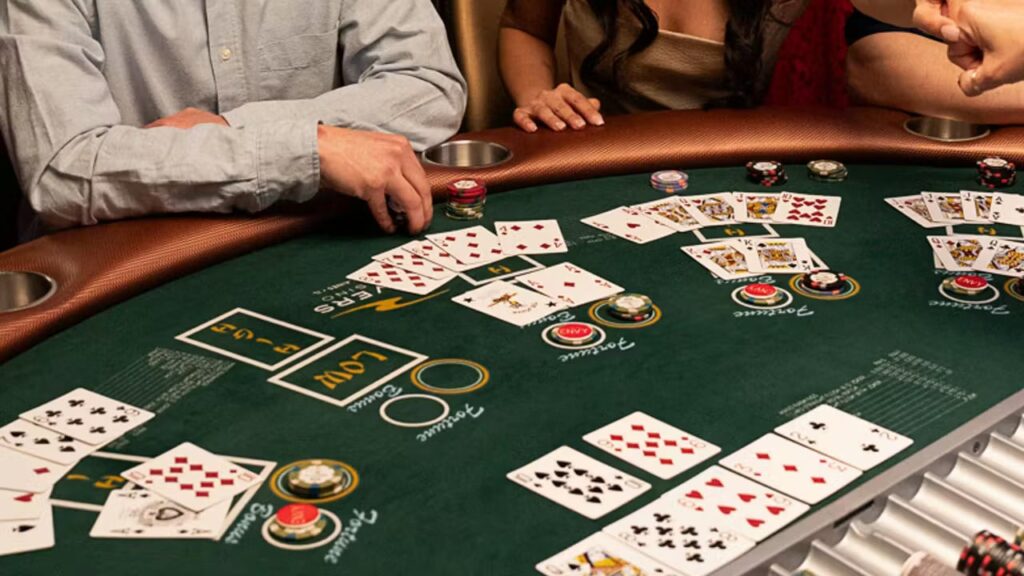
Pai Gow Poker is played with a standard fifty-two-card deck plus a single joker, which acts as a semi-wild card that can complete straights and flushes. Unlike fast-action games where you win or lose your entire wager in seconds, Pai Gow Poker is structurally designed for endurance. Each player receives seven cards, which must be split into two distinct hands: a five-card high hand and a two-card low hand.
The primary objective is simple yet tactical: both of your hands must beat the corresponding hands of the dealer. If you win both hands, you win your bet. If you lose both, you lose. However, if you win one and lose the other, the result is a push, meaning your original wager is returned to you intact. This push rate sits remarkably high, often hovering around forty percent depending on the specific rules of the table. That high frequency of ties is the secret weapon that brakes your bankroll burn rate, keeping you in the action long after other games would have cleared your chip tray.
Why Low Volatility Matters for Casual Players
Volatility in gambling measures how wildly your bankroll fluctuates over a given period. High-volatility games feature massive payouts offset by long dry spells, quickly shredding smaller bankrolls. Low-volatility games, by contrast, trade away those astronomical jackpots for steady, incremental action.
Pai Gow Poker is the undisputed king of low-volatility table games. Because a large percentage of hands end in pushes, your hourly expected loss is exceptionally low. For a recreational player, this translates to free drinks, complimentary lounge time, and hours of entertainment on a modest starting stake. Understanding how to maintain this low-volatility profile requires mastering the art of hand setting, particularly when dealing with split decisions.
The Art of Hand Setting: Avoiding Common Pitfalls
The most critical skill in Pai Gow Poker is hand construction. Every seven-card deal presents a mathematical puzzle. You must divide your cards so that your five-card hand outranks your two-card hand according to standard poker rankings, while maintaining balanced strength across both sections.
Beginners often make the mistake of over-allocating their strength to the two-card hand or failing to understand the rigid rules of house way guidelines. If your two-card hand accidentally beats your five-card hand, your entire hand is declared a foul and automatically forfeits to the house. To keep your play sharp and your volatility low, you must master the fundamental rules of hand setting.
The House Way and When to Deviate
Every casino provides a rulebook known as the house way, which dictates how the dealer must set any given seven-card combination. If you are ever unsure how to arrange your cards, you can simply ask the dealer for the house way, and they are legally obligated to set your hand according to casino protocol.
While the house way is mathematically sound and prevents players from making foolish mistakes, it is not always perfectly optimal against every scenario. However, for beginners aiming to minimize variance, sticking closely to the house way eliminates mental fatigue and keeps your decision-making streamlined. The key is knowing how to split pairs, handle full houses, and manage straight or flush draws without leaning into overly aggressive gambles.
-
Splitting Two Pairs: When you hold two pairs, the general rule is to keep them together in your five-card hand unless you have a high pair and an ace, or two high pairs that benefit from being split into a high-card two-card hand.
-
Handling Three-of-a-Kind: Unless you hold three aces, you should generally keep three-of-a-kind together in your five-card hand and play your two highest remaining cards in the two-card hand.
-
Utilizing the Joker: Remember that the joker is only partially wild. It can complete straights, flushes, and straight flushes, but it cannot stand alone as an ace unless it is completing a sequence.
The Impact of the Commission and Side Bets
Like baccarat, Pai Gow Poker features a commission structure to balance the house edge. Winning bets are typically subject to a five percent commission collected by the casino. While this commission ensures the house maintains its long-term mathematical advantage, the actual hourly cost to the player remains very low due to the high frequency of pushes.
The real danger to a low-volatility Pai Gow strategy comes from side bets. Modern Pai Gow tables almost always feature optional side wagers such as Fortune Bonus, Progressive Jackpots, or Emperor’s Challenge. These side bets promise massive payouts for hitting premium hands like seven-card straights or four-of-a-kind.
However, much like side bets in blackjack or baccarat, these optional wagers carry significantly higher house edges than the base game. If your goal is to slow down your bankroll burn rate, you must resist the temptation of the side bet circle. Sticking strictly to the standard base game wager preserves your capital and lets the natural push mechanics of Pai Gow do their work.
Managing Your Bankroll for Extended Play
Even in a low-volatility environment, proper bankroll management remains the cornerstone of smart gambling. Because Pai Gow games feature extended hand durations and frequent pushes, players often lose track of time and total investment.
To maximize your enjoyment, establish a dedicated session bankroll before sitting down at the felt. Divide that bankroll by your expected hourly betting volume to determine an appropriate table minimum. Because pushes return your money to play another round, a modest bankroll of one or two hundred dollars can easily sustain hours of relaxed play at a standard table minimum, provided you avoid chasing losses or dropping chips onto high-risk side bets.
Embracing the Social and Relaxed Pace of the Game
Beyond the mathematics and bankroll preservation, Pai Gow Poker offers an intangible benefit that sets it apart from almost every other table game in the pit: the communal atmosphere. Because every player at the table is playing against the dealer rather than each other, the table dynamic is naturally cooperative.
It is common for players to discuss how to set tricky hands, offer advice on the house way, and celebrate collective wins or shared pushes against a tough dealer hand. This relaxed environment removes the intense, high-stress pressure cooker atmosphere found at blackjack or craps tables. Combined with the slow cadence of the deal, Pai Gow provides a welcoming environment for newcomers and seasoned veterans alike.
Summary of Low-Volatility Pai Gow Strategies
Slowing down your bankroll burn rate in Pai Gow Poker comes down to disciplined execution and respect for the game’s unique mathematics. Keep these core principles in mind during your next casino visit:
-
Rely on the House Way: When in doubt, ask the dealer to set your hand according to the house way to eliminate costly errors.
-
Avoid Side Bets: Keep your money on the main betting circle to dodge high house edges and protect your bankroll from unnecessary volatility.
-
Appreciate the Push: Embrace the high frequency of ties as your primary tool for extending your playing time and minimizing hourly losses.
By approaching Pai Gow Poker with patience, discipline, and an appreciation for its low-volatility structure, you can enjoy a sustainable, entertaining, and financially controlled casino experience that outlasts the frantic pace of the rest of the floor.
